
The risk of manual handling of loads is one of the most underestimated occupational risks in the workplace. Yet the consequences it produces can be serious and long-lasting: hernias, chronic back pain, acute injuries that change a worker’s life. In this article, we analyse why it is overlooked, what effects it has on health and how to prevent it concretely, also in light of the guidelines issued by ASL3 Liguria.
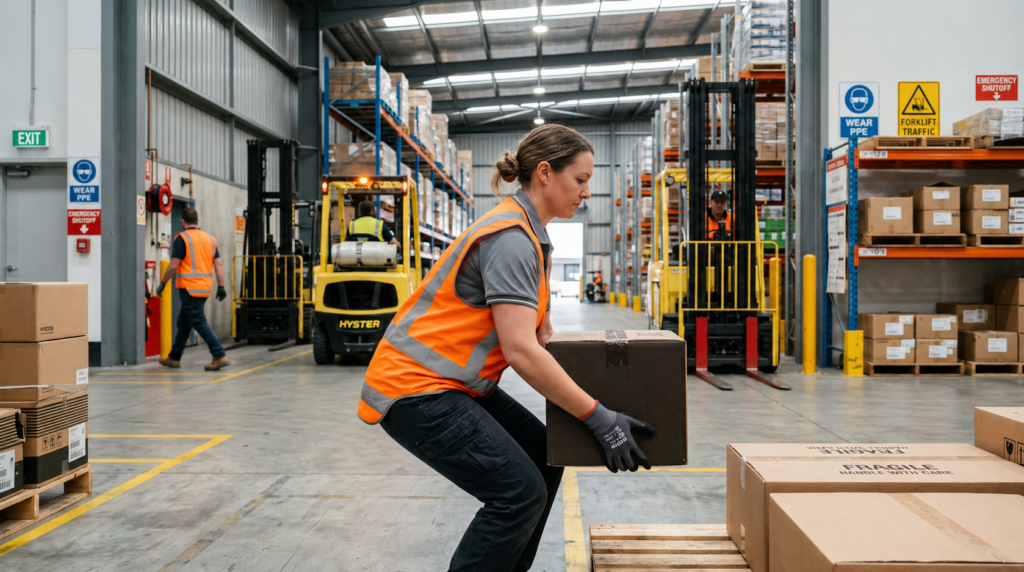
A silent and growing threat
The risk from manual handling of loads is insidious precisely because it does not make the news. It almost never causes a spectacular accident, it does not generate immediate alarms. Yet Musculoskeletal Disorders (MSDs) represent today the leading cause of occupational diseases in Italy (and in Europe), with an incidence of over 60% of the total reported conditions.
The pain creeps in slowly: a few weeks, a few months. It starts with discomfort in the back, shoulders, wrists. It is often ignored, mistaken for tiredness or “normal fatigue”. Then, when the worker finally decides to see a doctor, the damage is already chronic. The occupational disease is established.
This is the first reason for its dangerous underestimation: the absence of a visible traumatic event. As highlighted by the ASL3 Liguria safety brochure, handling risk builds day after day, through repeated gestures, incorrect postures, excessive loads. It is a wear-and-tear process that is not perceived as an “emergency” until it is too late.
The domino effect that hits the entire organisation
A handling injury is never an isolated problem. When an operator is absent due to back pain, a chain reaction is triggered that involves the entire company:
- Overloading of colleagues, who must cover the vacant shift, often performing handling tasks in a hurry and with greater exposure.
- Increased risk of new injuries: fatigue, stress, repeated gestures in non-ideal conditions multiply the probability of accidents.
- Productive slowdown: pace drops, errors increase.
- Deterioration of product or service quality.
- Repercussions on the supply chain (delivery delays, logistical misalignments).
The cost is not just that of the individual injury: it is a systemic cost that undermines performance, reputation and the company climate.
Why do we ignore this risk? (The real question)
Underestimation stems from a mix of factors:
Normalisation of fatigue: “We have always done it this way”, “A bit of back pain is part of the job.”
Lack of visible data in small numbers: in a micro-enterprise, a single case every 5 years is filed as bad luck, without analysis.
Poor perception of indirect costs: companies often stop at the medical/insurance expense, forgetting the costs of disorganisation, training of the replacement, productivity loss.
Lack of specific assessment: regulations (D.Lgs. 81/2008, Title VI and Annex XXXIII) require the assessment of handling risk, but many companies approach it superficially, without applying standardised methods (NIOSH, Snook & Ciriello, OCRA checklist for repetitive movements).
ASL3 itself, in its publication, reminds us that the assessment is not a bureaucratic formality: it must be carried out by measuring weight, frequency, distance, grip height, twisting — and updated every time the work organisation changes.
How to prevent it effectively: the 3 pillars (plus one)
Prevention of handling risk cannot be improvised. It is based on four foundations, of which the first three are already known but must be implemented with method:
Training on correct gestures and postures — but not just theory
The ASL3 brochure insists on the importance of practical training: every operator must know the lifting techniques (straight back, bent knees, load close to the body, avoid twisting), but must also practise them with real loads and in their actual workstations.
Key point: teach workers to recognise the first signs of fatigue and to report them without fear.
Integrating mechanical aids — starting from the design stage
Pallet trucks, forklifts, conveyor belts, vacuum lifters, articulated arms: the technology exists. But to be effective it must be chosen based on the task, positioned for easy access and maintained.
ASL3 reminds us that the employer’s primary obligation is to eliminate manual handling, where possible, replacing it with mechanical equipment.
Rotating workstations and tasks — in a structured way
Task rotation cannot be random: it must be designed to genuinely limit cumulative exposure to repetitive gestures. This means mapping tasks, calculating the risk index for each workstation and rotating workers so that the muscle groups engaged are different.
(The additional pillar) Health surveillance and active involvement
The law provides for health surveillance for workers exposed to handling risk. But the medical examination is not an automatic stamp: it is an opportunity to detect symptoms early and, above all, to give workers a voice. A near-miss and musculoskeletal discomfort reporting system allows issues to be corrected before they become occupational diseases.
An integrated vision for lasting results
Manual handling risk management cannot be a standalone activity. It must be embedded in an Integrated Management System (IMS) that combines safety, quality and environment.
An ergonomic layout reduces injuries but also improves work quality and productivity. Correct handling avoids not only injuries to workers, but also damage to materials, waste and non-conformities. Integrating systems allows prevention to be transformed into a lever of efficiency and competitiveness, not a cost.
To summarise: three immediate actions
- Today: observe the handling operations in your company. Are there twisting movements, loads held far from the body, lifts from the floor? If yes, you already have a risk to manage.
- This week: hold a meeting with workers to gather reports of pain or fatigue. Then go and review the risk assessment.
- This month: invest in a mechanical aid or redesign a critical workstation. This is the action that gives the fastest return in terms of health and productivity.
To go further, read the full ASL3 Liguria brochure on manual handling of loads — a practical, clear and free guide for all employers and safety managers (RSPP).